


Often the only alternative to a root canal is removing the tooth and then replacing it, says the American Association of Endodontists (AAE). Some adult teeth with an irritated but living pulp may suit vital pulp therapy instead. A tooth that already had a root canal can sometimes be treated again. For most tooth nerve problems, the ADA favors dental treatment over antibiotics. In Plano, your dentist decides after testing the pulp and imaging the tooth.
Last Updated: October 22, 2026
Many people who are told a tooth needs a root canal start asking what else they could do. This guide lays out the real options, so you know what each one involves.
At Vitality Dental, we explain each path before anything starts. The right option depends on the state of the pulp and the tooth around it.
If cost is on your mind, the total depends on the whole plan, including any replacement tooth. We explain each option and its price before we begin.
What a Root Canal Alternative Really Means in Plano
A root canal cleans out an infected or badly damaged pulp, the soft tissue with nerves and blood vessels inside your tooth. The American Association of Endodontists (AAE) says the only alternative is often removing the tooth. Some teeth with an injured but still living pulp may be able to keep it.
The American Dental Association (ADA) says the pulp can get infected after a deep cavity, repeated dental work, a crack or an injury. We perform root canal therapy in Plano at our Coit Road office.
Some cases go to an endodontist, a dentist who focuses on the pulp and the tissue around the root. Our guide to which dentist handles root canal work in Plano explains who does what. If a tooth already aches, you can book an appointment so we can test it before you decide.
The Main Options Your Dentist May Weigh Instead
A living pulp may suit vital pulp therapy, while a pulp past saving points to a root canal or an extraction. If an earlier root canal did not heal, retreatment may be possible. The ADA’s 2019 guideline leans toward dental care over antibiotics for most of these cases.
Vital Pulp Therapy for a Pulp That Can Recover
Vital pulp therapy aims to keep an injured pulp alive and working. In 2021, the AAE supported it as an option for some adult teeth with injured pulps and fully formed roots.
Before that, only a root canal or an extraction may have been considered for those teeth. You may hear the terms pulp capping and pulpotomy.
Cleveland Clinic says a pulpotomy removes the damaged pulp in the crown and leaves the root in place. It is most often done on baby teeth, but a dentist may suggest it for some adults. Your dentist can tell you if it fits your tooth.
Extraction With a Plan to Replace the Tooth
MedlinePlus describes an extraction as removing the tooth from its socket in the jaw. Removing the tooth deals with the infected pulp, but it leaves a gap. The AAE says an extracted tooth should be replaced with an artificial one.
We offer tooth extractions with a focus on how to rebuild your smile afterward. If you lean toward this path, plan the replacement at the same time.
The AAE also notes that replacing a missing tooth takes extra visits. Count those visits when you compare your options.
Retreatment and Endodontic Surgery for a Treated Tooth
A tooth treated with a root canal before may not heal, or it may develop new problems. The AAE says it can sometimes be treated again. Narrow or curved canals and new decay are two reasons this can happen.
If retreatment is not an option, endodontic surgery may be considered. An apicoectomy works at the root tip when inflammation or infection stays around the end of the root.
The AAE notes that extraction is often the only alternative to surgery. Your dentist may refer you to an endodontist for either of these steps.
Antibiotics and Waiting It Out
The ADA’s 2019 guideline recommends against antibiotics for most tooth nerve and root tip problems. It favors dental treatment and, if needed, over-the-counter pain relievers. Antibiotics may be added if the infection spreads and brings fever or feeling unwell.
Waiting has its own risk. MedlinePlus notes a toothache may stop while the infection keeps spreading. Our post on the 3-3-3 rule for tooth infection pain covers short-term relief.
Fever or feeling unwell with tooth pain can mean the infection is spreading, so get care right away. If swelling spreads toward your eye or neck, or you have trouble breathing or swallowing, call 911 or go to the nearest ER. Our night and weekend toothache guide covers after-hours steps.
Replacing a Tooth After an Extraction
Replacing an extracted tooth matters, the AAE says, since a gap can let nearby teeth shift. Implants, fixed bridges and removable partial dentures are the options the AAE lists. Each one adds visits and planning, so ask about them before the tooth comes out.
| Replacement | What It Involves | What to Weigh |
|---|---|---|
| Dental implant | A post placed in the jaw that anchors a new tooth | Healing often takes months; the AAE cites three to six. The ADA says your health matters more than your age. |
| Fixed bridge | A false tooth attached to the teeth on either side; only a dentist can remove it | Often involves work on the healthy teeth next to the gap |
| Removable partial denture | A replacement you can remove, unlike a fixed bridge | Often involves work on nearby healthy teeth too |
The AAE calls root canal treatment and implants both viable options. It suggests starting by trying to save your natural tooth.
We place dental implants in Plano and the final restoration in house. In some cases, an implant can go in at the same visit the tooth comes out, and we assess that at the exam.
Our post on what happens to the jawbone after a tooth is lost explains why timing matters.
How the Choice Gets Made at Our Plano Office
The choice starts with tests at your exam that check whether the pulp can recover or is past that point. Then 3D imaging shows the roots and the bone, and you hear every option and its price before anything begins.
Testing Whether the Pulp Can Recover
Our exam helps sort two kinds of pulp inflammation. Reversible pulpitis means the pulp is irritated but may settle with a filling.
Irreversible pulpitis means the pulp is not expected to heal. In that case, we look at a root canal or an extraction.
Your own notes help too. Tell us when the pain started, what sets it off and how long it lasts.
Catching decay early can widen your choices. The National Institute of Dental and Craniofacial Research (NIDCR) says early decay can sometimes be reversed with fluoride before a cavity forms.
Imaging the Roots and the Bone Around Them
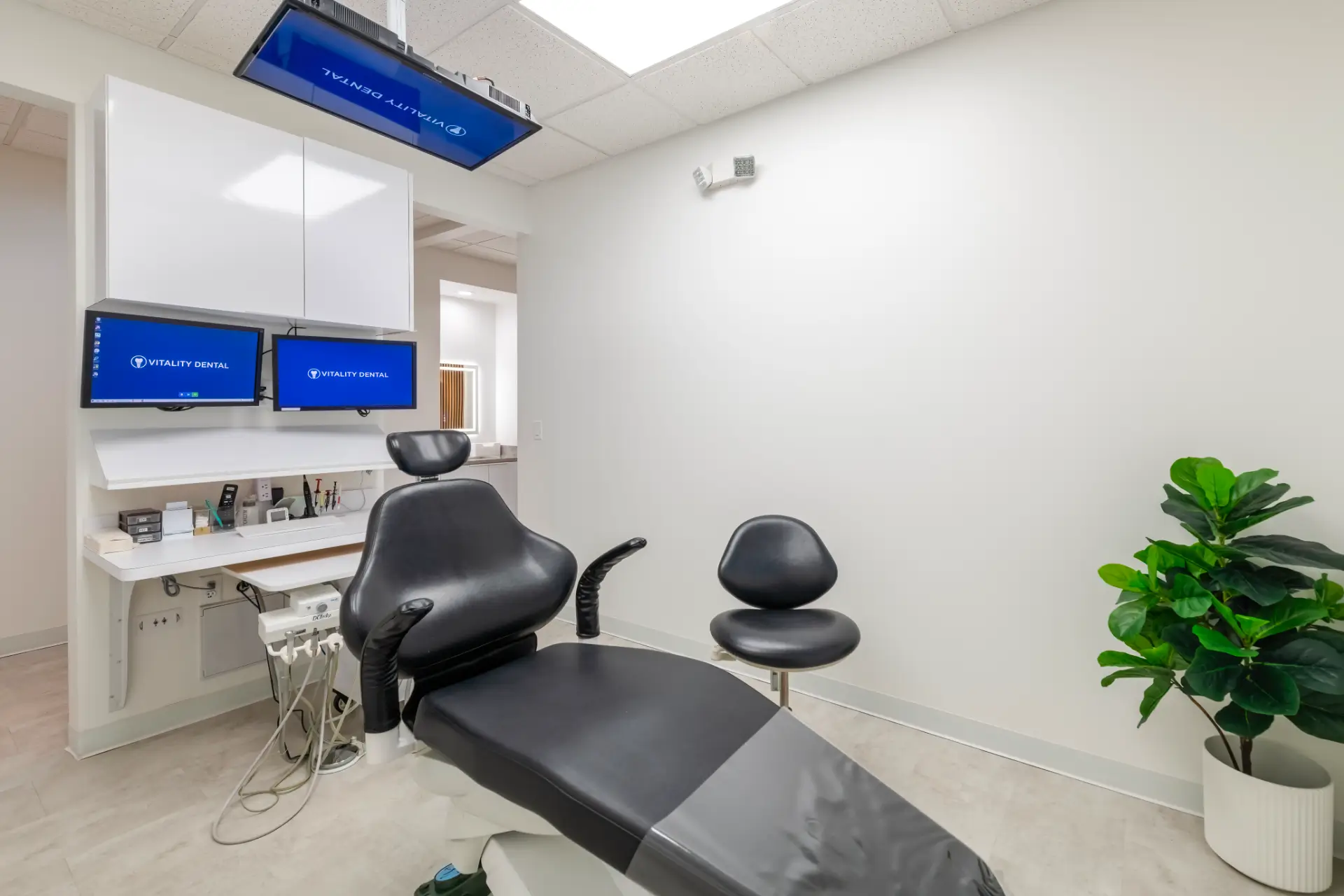
We use 3D cone beam (CBCT) imaging to see the shape of your root canals. It can also show fractures, abscesses and bone changes in three dimensions.
If your tooth can be saved, we’ll tell you. If it must go, we explain why, using visual aids so you can see what is happening.
The AAE notes that saving a tooth is not always possible. Seeing your own images helps you weigh each path with clear facts.
Comfort, Coverage Questions and Timing
If nerves are part of the worry, we offer sedation from nitrous oxide to oral conscious sedation. You can ask about it at your exam.
We check your benefits before treatment, so you know where you stand. If you have no insurance, ask about our in-house membership plan.
Our office is open Monday to Friday, 7 AM to 3 PM. Bring your questions, and we will go through each option before you decide.
This post is general information and not a diagnosis. Ask your dentist whether this applies to you.
Making the Call on Your Tooth With a Plano Dentist
Root canal alternatives come down to the state of your pulp, the tooth around it and your plans for any gap. A careful exam with testing and 3D imaging turns those questions into a clear choice for your own tooth.
At Vitality Dental, we show you the images and talk through each choice with you. Book an exam that weighs every option for your tooth at (972) 964-3800.
Frequently Asked Questions
What happens if I avoid a root canal?
If you avoid needed treatment, the infection may keep going even if the pain fades. MedlinePlus notes a toothache can stop while the infection keeps spreading. The ADA warns that bacteria can damage the bone that holds your tooth, so you could lose it. Untreated abscesses can lead to serious infection, so watch for the warning signs above.
What is more painful, an extraction or root canal?
Both are usually done after your dentist numbs the area with local anesthesia. How you feel afterward varies from person to person and from tooth to tooth. If you feel anxious, you can ask us about nitrous oxide or oral conscious sedation. Ask your dentist what to expect for your own tooth.
What are the disadvantages of a root canal?
A root canal often needs a follow-up visit for a filling or crown to protect the tooth. Once the pulp is removed, the tooth can become brittle, so we often recommend a crown. A treated tooth can also sometimes need treatment again later. Your dentist can explain how this applies to you.
Why do dentists prefer root canal over extraction?
The AAE says the main advantage of a root canal is that it keeps your natural tooth. It suggests starting by trying to save that tooth. If a tooth is removed, the AAE says it should be replaced, which adds visits. Your dentist weighs these points against the state of your tooth.
What are the signs you need a root canal?
Signs can include a severe toothache that does not go away, or a pimple-like bump on your gums. Deep cavities, repeated dental work, cracks and injuries can all harm the pulp. Only a dentist’s exam can confirm whether you need treatment. Our post on what damages teeth the most covers common causes.

 Is It Worth Getting Dental Implants at 70 Years Old in Plano?