
Key Takeaways
- When a tooth is lost, the jawbone beneath it begins to resorb. Early bone changes can begin within weeks of extraction
- Research indicates up to 25% of bone width may be lost in the first 12 months; in some cases, studies suggest that figure may reach 50% or more over three years
- Bone loss from a missing tooth isn’t just a dental concern; over time, it can visibly affect the shape and structural support of your face
- A Dental Implant is the only tooth-replacement option that replaces the root, stimulates bone, and addresses bone loss at the source
When you lose a tooth, the gap is obvious. What’s happening underneath it isn’t.
Beneath that space, where your tooth root used to be, your jawbone has already begun a quiet, gradual process called resorption. Your body, detecting that bone is no longer needed to support a root, starts breaking it down and redirecting those minerals elsewhere. There’s no pain. No signal. Most patients have no idea it’s happening.
But the timeline matters more than most people realize. Research indicates that early bone changes can begin within weeks of an extraction, and studies suggest that within the first 12 months alone, the jawbone in that area can lose approximately 25% of its width. Left unaddressed over several years, that number can climb considerably higher.
If you’ve recently had a tooth extracted, or you’ve been carrying a gap for longer than you planned, this article explains what’s actually happening beneath the surface, why timing matters, and what your real options are for protecting both your jaw and your face.
How Does a Missing Tooth Cause Bone Loss?
Most people understand that teeth need bone to stay anchored. What’s less understood is that the relationship works in both directions.
The Role of Your Tooth Root in Keeping Your Jaw Healthy
Your tooth root does far more than hold the tooth in place. Every time you bite, chew, or simply bring your teeth together, that mechanical force travels down through the root and into the surrounding bone tissue. That stimulation is the signal your body needs to maintain the bone, continuously building, sustaining, and renewing it.
When the root is gone, so is the signal.
Your body interprets that absence as confirmation that the bone is no longer in use. And it begins resorption, gradually breaking down the bone structure in that area and reclaiming those minerals for use elsewhere in the body.
What “Bone Resorption” Actually Means
In practical terms, what resorption looks like over time is this: the ridge of your jaw in that area becomes narrower and shorter. The teeth on either side of the gap may begin to drift or tilt toward the space. The bone that once gave structure to that section of your face begins, slowly, to recede.
It’s a gradual process, which is exactly why it’s so easy to put off addressing, and exactly why understanding the timeline matters before the window for simpler options narrows.
How Fast Does Jawbone Loss Happen After Tooth Loss?
This is the question most patients don’t think to ask, until after the period of easier intervention has already passed.
The Bone Loss Timeline: 3 Months, 12 Months, 3 Years
Based on published oral surgery and implantology research, the general pattern of bone loss following tooth extraction looks like this:
- Within the first 3 months: Early bone remodeling begins as the extraction site heals. Resorption is already underway at the cellular level before any visible change occurs.
- Within 12 months: Research indicates that the jawbone in the area of a missing tooth can lose approximately 25% of its width during this first year, the most active phase of resorption.
- Over 3+ years: In some cases, studies suggest bone width loss may reach 50% or more, with a corresponding reduction in bone height. The longer a gap remains unaddressed, the more the bone changes, and the more complex the path to restoration typically becomes.
Plano patients often come to our team after having been told by a previous provider that they could “wait and figure it out later.” That’s not inaccurate. But “later” has a cost, and it’s measured in bone volume and treatment complexity, not just time.
Can Losing One Tooth Change the Shape of Your Face?
Yes, and this is the part of the conversation most patients are never part of.
The Facial Aging Connection Most Patients Are Never Told About
Your jawbone isn’t simply a structural base for your teeth. It’s a core component of the three-dimensional scaffolding that gives your lower face its definition, the projection of your chin, the contour of your jaw near your cheeks, the support beneath your lips, and the surrounding soft tissue.
When bone begins to resorb in that area, the tissue above it, gum tissue, facial muscle, and skin, gradually loses its underlying foundation. Over time, this can contribute to subtle but real changes in facial appearance: a slightly softened jawline, a hollow quality near the affected area, an overall look that patients often describe as “I look older than I am” or “my face feels different on that side.”
This isn’t a vanity observation. It’s a documented physiological pattern, and it’s the same biological mechanism responsible for the collapsed, sunken facial appearance associated with extensive tooth loss and significant aging.
Your facial structure isn’t just about appearance. It’s connected to how you chew, speak, and carry yourself every day. For patients who lose a single tooth, particularly in a visible or functionally important area, this connection becomes personal very quickly.
This is why our team frames a well-timed Dental Implant not simply as a restoration, but as a facial preservation decision. An implant placed before significant bone loss occurs doesn’t just close the gap. It maintains the three-dimensional bone volume that your face depends on. No competitor is making that connection clearly. We think patients deserve to hear it.
Dental Bridge vs. Implant: Which One Actually Stops Bone Loss?
If you’ve already started researching, you’ve likely encountered two main options: a dental bridge or a Dental Implant. Many patients are told it’s a matter of personal preference or budget. That framing leaves out the most clinically significant difference between them.
| Dental Bridge | Dental Implant | |
| Bone Preservation | Does not stop bone loss | Stimulates and preserves bone |
| Longevity | 10–15 years on average | 20+ years with proper care |
| Adjacent Teeth Impact | Requires reshaping neighboring teeth | Freestanding; no impact on adjacent teeth |
| Facial Structure | Does not address bone volume loss | Maintains bone volume and facial support |
| Cost Consideration | Lower upfront cost | Higher upfront; often lower long-term cost given longevity |
Why a Bridge Doesn’t Protect the Jawbone
A dental bridge is a surface-level restoration. It replaces the visible crown of the missing tooth, the part above the gumline, but it does not replace the root. And because the root is what stimulated the underlying bone, a bridge does nothing to interrupt resorption. The bone continues to break down underneath it, silently, while the bridge sits above.
This is not a dismissal of bridges; they are a clinically appropriate choice in certain situations. But patients deserve to understand the trade-off clearly: choosing a bridge over an implant is not a neutral, equivalent decision. For patients with sufficient healthy bone, an implant isn’t just the premium choice. It’s the preventive one.
How a Dental Implant Stimulates Bone and Preserves Structure
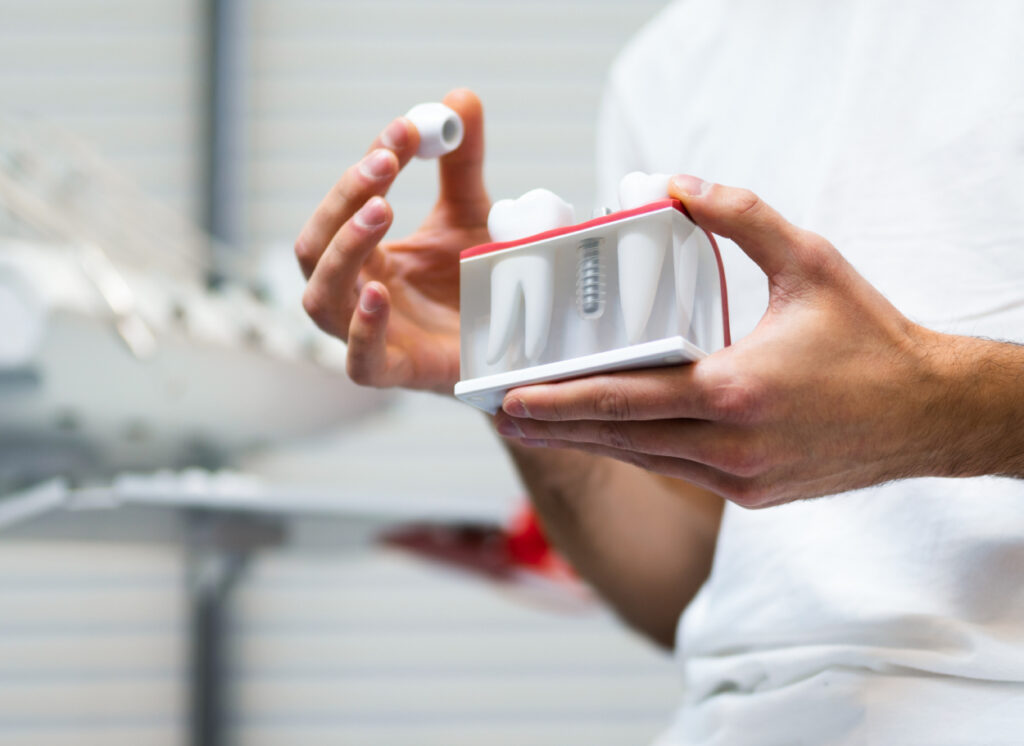
A Dental Implant replaces the entire tooth, root, and crown. The implant post, typically made of biocompatible titanium, is placed directly into the jawbone. Over the following months, the bone fuses around it through a process called osseointegration, becoming, functionally, a part of your jaw.
Every time you bite or chew, that force transmits through the implant into the bone, exactly as a natural root would. The bone receives the stimulation it needs to maintain itself. Resorption in that area stops.
At Vitality Dental, every implant is planned using 3D cone beam imaging, a technology that gives our team a precise, three-dimensional picture of your bone density, volume, and anatomy before a single incision is made. This means accurate placement, minimized recovery, and outcomes that are built to last.
Not sure where you stand?
If you’ve recently had a tooth extracted or you’ve been living with a gap for longer than you expected, our team at Vitality Dental can take a comprehensive look at your bone health and walk you through your options clearly, without pressure.
New patients and emergency appointments are always welcome.
Schedule a consultation at our Plano office →
Can Bone Loss From a Missing Tooth Be Reversed?
Not on its own, but it can very often be addressed.
Once bone volume is lost, the body doesn’t spontaneously rebuild it. However, bone grafting procedures can restore sufficient volume in the affected area to support a successful implant, even in patients who have been living with a gap for an extended period.
When a Bone Graft May Be Needed Before an Implant
Depending on the extent of bone loss, some patients require a bone graft before an implant can be placed. This involves adding bone material to the area of deficiency, allowing it to integrate and rebuild density over a healing period, typically a few months.
A graft doesn’t make an implant impossible. It does make the process longer and more involved. It’s one of the primary clinical reasons why patients who move forward sooner, before significant bone loss has occurred, often have a simpler, more straightforward path to a successful outcome.
It’s also worth noting: not every patient with a missing tooth requires a graft. A comprehensive evaluation, including imaging, is what determines that, and that conversation belongs in a consultation room, not on a website.
How Long Can You Wait Before Getting a Dental Implant?
There is no single universal deadline. But there is a window, and it matters.
The Window That Matters, And What Happens If It Closes
The earlier an implant is placed following extraction, the more bone is typically available to support it, and the less likely a bone graft becomes necessary. Research generally identifies the first year post-extraction as the most favorable window for implant placement, before the most active phase of resorption has significantly altered the available bone structure.
That said, patients who have waited months or even years are rarely without options. Modern implant dentistry, including the advanced techniques used at Vitality Dental, has made successful implant placement possible even in cases with meaningful bone loss, often in combination with bone grafting and precise 3D-planned placement.
What the window refers to is simplicity. Acting sooner typically means fewer steps, a shorter treatment timeline, and a more predictable outcome. The longer a gap remains unaddressed, the more variables are introduced.
What to Do Next
Here’s the part that tends to get left out of articles like this: the good news is real.
Bone loss from a missing tooth is one of the most treatable conditions in modern dentistry. Whether you had an extraction last month or two years ago, there is almost certainly a clear path forward. What that path looks like depends on how much bone remains in the affected area, the location of the missing tooth, and what outcome you’re hoping to achieve, and those are precisely the questions a comprehensive evaluation with the right imaging can answer.
Dr. Andrew Kung and the team at Vitality Dental approach every implant consultation with Fellowship-level implant training. Dr. Kung holds a Fellowship in both the Academy of General Dentistry and the International Congress of Oral Implantologists, along with 3D cone beam imaging that allows for precise, individualized treatment planning. Having personally undergone extensive dental treatment and lived through the experience of weighing significant dental decisions himself, Dr. Kung understands what that seat across from the dentist actually feels like. That shapes how our team communicates and how we care.
If you’ve been telling yourself “it’s just one tooth” while quietly wondering whether that’s actually true, trust that instinct. It was worth googling. It’s worth a real conversation.
Schedule Your Consultation at Vitality Dental
Our Plano implant team is here to evaluate exactly where you stand and explain your options, with no pressure, no jargon, and a thorough look at your actual bone health.
Schedule Your Comprehensive Consultation →
We welcome new patients and same-day appointments. We work with most major insurance plans, and our team is happy to walk you through your benefits. No insurance? No problem, ask about our in-house dental plan with no deductibles, no yearly maximums, and immediate eligibility.
Vitality Dental | 1220 Coit Rd #106, Plano, TX 75075
This article is for informational purposes only and does not constitute dental or medical advice. Individual cases vary significantly, and the information provided here is not a substitute for a professional dental evaluation, diagnosis, or treatment recommendation. Results from Dental Implant treatment vary by patient. Please consult a licensed dental professional for guidance specific to your clinical situation.
Frequently Asked Questions
What happens if you don’t replace a missing tooth?
When a tooth goes unreplaced, the jawbone beneath the gap begins to resorb because the stimulation provided by the tooth root is no longer present. Over time, this bone loss can cause neighboring teeth to shift or tilt toward the gap, alter your bite, and contribute to visible changes in the shape of the surrounding facial structure. The longer the gap remains, the more bone is typically lost, which can make future restoration more complex and may require additional procedures such as bone grafting.
How long after a tooth extraction does bone loss begin?
Early bone remodeling can begin within weeks of a tooth extraction. Research indicates that the most significant phase of bone width reduction typically occurs within the first 12 months following extraction, during which studies suggest approximately 25% of bone width may be lost. This is why the timing of tooth replacement, particularly with a Dental Implant, carries more clinical significance than many patients initially realize.
Is a dental implant better than a bridge for preventing bone loss?
For patients concerned with long-term bone health and facial structure, a Dental Implant is the only tooth-replacement option that addresses bone loss at the root level. A dental bridge replaces the visible portion of the missing tooth but does not replace the root, meaning bone resorption continues underneath the bridge over time. A Dental Implant replaces the root, stimulates the jawbone through normal chewing forces, and halts the resorption process in that area. Whether an implant is clinically appropriate for a specific patient depends on bone volume, overall oral health, and individual factors. A consultation with a qualified implant dentist is the right first step.

 The “No-Drill” Facelift: Transforming Smiles with Composite Bonding