
Written by Dr. Andrew Kung, DDS — Fellow, Academy of General Dentistry & International Congress of Oral Implantologists | Medically reviewed by the clinical team at Vitality Dental, Plano, TX

Key Takeaways
- Dental fear is one of the most common reasons people delay implant treatment — and it is completely valid. You are not alone, and you are not being irrational.
- Modern Sedation Dentistry options — including IV sedation, oral sedation, and nitrous oxide — mean you can be deeply relaxed or fully asleep for your entire procedure.
- At Vitality Dental in Plano, TX, our comfort protocols go far beyond sedation: noise-canceling headphones, weighted blankets, and 3D-guided technology that shortens surgical time significantly.
- The first step is a no-pressure consultation — not a commitment. Our team’s only job that day is to listen and answer your questions.
Overcoming fear of dental implants typically starts with one realization: the procedure you are imagining is almost certainly more intense than the one you would actually experience. With modern sedation options and advanced surgical technology, most patients at our Plano practice describe the process as far more manageable — and far less painful — than they anticipated.
But we know that knowing something intellectually and feeling it emotionally are two very different things. If fear has kept you from addressing missing or failing teeth, this guide is for you.
Is It Normal to Be Terrified of Dental Implants?
Yes — completely. Dental anxiety affects an estimated 9–15% of Americans, and for many people, the fear of a surgical procedure like implant placement is even more intense. If you have avoided the dentist for years — or even decades — because of a past painful experience, a feeling of helplessness in the chair, or simple dread of the unknown, that response is not weakness. It is a protective instinct your nervous system developed for a reason.
At Vitality Dental, we hear this every day. Patients come to us having delayed necessary treatment for years, sometimes with significant consequences for their oral health, because no one ever made them feel safe enough to walk through the door. That changes here.
If you’re afraid of visiting the dentist, you have absolutely nothing to be ashamed of. Our entire practice — from the way our front desk answers the phone to the sedation protocols Dr. Kung uses in surgery — is built around that truth.
What Does Getting a Dental Implant Actually Feel Like?
One of the most powerful ways to reduce fear is to replace the unknown with the specific. Here is a transparent, step-by-step look at what the physical experience typically involves.
Before the procedure: Your consultation begins with a comprehensive 3D cone beam imaging scan — a low-radiation, full-picture view of your jawbone, nerves, and surrounding anatomy. This isn’t just a routine X-ray; it allows Dr. Kung to plan your implant placement with exceptional precision before he ever picks up a surgical instrument. Less guesswork means a shorter, more predictable surgery.
Day of surgery: Once your sedation takes effect (more on your options in the next section), the area around the implant site is numbed with local anesthetic. Most patients under sedation report little to no awareness of the procedure itself. The implant post — a small titanium fixture — is placed into the jawbone. The entire surgical appointment for a single implant typically ranges from one to two hours, though this varies based on your individual case.
Immediately after: Some soreness and mild swelling in the days following surgery are normal and typically manageable with over-the-counter pain relief. Most patients are surprised by how tolerable the recovery feels compared to what they had imagined. According to the American Academy of Implant Dentistry, most patients report that implant placement is less uncomfortable than a tooth extraction.
The healing phase: The implant gradually fuses with your jawbone over several months — a natural process called osseointegration. Once complete, the final crown is attached, and the result is a restoration that looks, feels, and functions like a natural tooth.
Can You Be Put to Sleep for Dental Implants?
Yes. This is one of the most important things we want anxious patients to know: you do not have to be awake for this procedure.
At Vitality Dental, we offer three levels of Sedation Dentistry to match your comfort level and anxiety needs:
- Nitrous Oxide (Laughing Gas): Inhaled through a small mask, nitrous oxide produces a calm, floaty sense of relaxation within minutes. You remain conscious and can respond to the team, but the edge of anxiety typically disappears. Effects wear off quickly, so you can often drive yourself home.
- Oral Sedation: A prescription medication taken before your appointment produces a deeper state of drowsiness. Most patients have little to no memory of the procedure. You will need a driver, and the relaxed feeling may last several hours.
- IV Sedation: Administered directly into the bloodstream by a trained clinician, IV sedation produces the deepest level of relaxation available in a dental office setting. Many patients describe it as being “completely asleep.” Your vital signs are monitored continuously throughout the procedure. This is the preferred option for patients with severe dental phobias or those undergoing more complex implant surgery.
Choosing sedation is not a sign of weakness — it is a clinical tool, and we encourage you to use it. Our team will help you determine which level is most appropriate based on your health history and anxiety level during your consultation.
What Happens If Anxiety Spikes During the Procedure?
This is a question we are genuinely glad patients ask, because having a clear answer before you sit down in the chair can itself reduce anxiety significantly.
If you experience heightened anxiety during a procedure — even under sedation — our clinical team is trained to respond immediately. With IV sedation, medication levels can be adjusted in real time to deepen your relaxation. For patients under lighter sedation, we use a simple communication system: a raised hand means “stop,” and everything pauses until you feel ready to continue. No one will push through if you are uncomfortable.
Dr. Kung’s calm, measured approach in the operatory is not incidental — it is intentional. He has personally undergone extensive dental treatment himself and understands viscerally what it feels like to be on the patient’s side of the chair. That lived experience shapes how our entire team communicates during procedures.
How Vitality Dental’s Comfort Menu Works
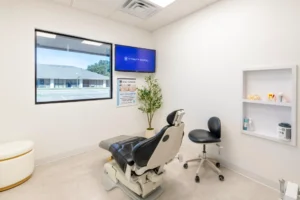
Most dental practices list “sedation” as a comfort option and leave it there. At Vitality Dental, we think about the sensory environment of your entire visit — because anxiety isn’t just about the procedure. It starts in the parking lot.
Here is what the experience at our Plano office typically looks like for an anxiety-aware patient:
- Noise-canceling headphones are available so you can listen to music, a podcast, or simply block out the ambient sounds of the operatory that many patients find triggering.
- Weighted blankets are offered to patients who find deep pressure soothing — a clinically recognized comfort technique for anxiety management.
- Scent management in our operatory is intentional. The sharp chemical smell of a traditional dental office is a powerful anxiety trigger for many patients. Our modern, comfortable office environment is designed to feel less clinical and more welcoming from the moment you walk in.
- Warm, unhurried communication from our team before and during every appointment. We will explain what we are doing before we do it — always.
- Early morning appointments starting at 7:00 AM for patients who find it easier to “get it over with” before the day’s stress accumulates.
Your comfort is as important as your smile. That is not a tagline for us — it is the standard we hold ourselves to with every patient.
The Technology That Makes It Faster (and Less Scary)
Here is something competitors rarely say plainly: the more precisely a procedure is planned, the shorter and less traumatic it is.
At Vitality Dental, our investment in advanced dental technology is directly connected to your comfort — not just our clinical outcomes.
Our 3D cone beam imaging system creates a complete three-dimensional map of your jaw before surgery begins. Dr. Kung uses this to identify the exact placement angle, depth, and position of your implant with a level of accuracy that simply was not possible a decade ago. The result is a procedure that is faster, involves less tissue disruption, and carries a lower risk of complications.
Our 3D intraoral scanner eliminates the need for traditional impression trays — the gag-inducing process of biting down on putty that many anxious patients dread. Digital impressions are faster, more comfortable, and more accurate.
Soft-tissue lasers used in certain implant procedures allow for quicker, more precise work with significantly less bleeding and post-operative discomfort than traditional instruments.
As a Fellow of the International Congress of Oral Implantologists, Dr. Kung’s training is specifically focused on complex implant cases — including full-mouth rehabilitation for patients who have been living with significant tooth loss. If your situation feels complicated or “beyond fixing,” it very likely is not.
Frequently Asked Questions
How painful is getting a dental implant compared to a tooth extraction?
Most patients report that implant placement, when performed under appropriate sedation and local anesthetic, is comparable to or less uncomfortable than a tooth extraction. Post-operative soreness typically peaks within the first 48–72 hours and is usually manageable with over-the-counter anti-inflammatories. Your specific experience will depend on your case complexity and the sedation level you choose.
How long does a dental implant procedure actually take?
A single implant surgery typically takes one to two hours. More complex cases — such as multiple implants or procedures requiring bone grafting — may take longer. Your treatment timeline will be clearly outlined during your consultation, so there are no surprises.
What is the least painful way to get dental implants?
IV sedation combined with local anesthetic is generally considered the most comfortable option for highly anxious patients, as it produces the deepest relaxation and the least conscious awareness of the procedure. Our team will help you determine the right approach for your specific situation.
Is it normal to cry at the dentist from fear?
Absolutely. Many of our patients have experienced this — and our team will never make you feel embarrassed for it. Emotional responses to dental fear are physiological, not a reflection of your character. We have helped patients through every level of anxiety, and we will meet you exactly where you are.
Can I explore my implant procedure steps before committing to anything?
Yes. Your consultation is a conversation, not a commitment. We will walk you through every step of the process, answer every question you have, and help you understand exactly what to expect — before you ever schedule a surgery date.
What To Do Next: You Don’t Have to White-Knuckle This Alone
If you have been living with missing or failing teeth — quietly carrying the weight of a smile you feel you have to hide — we want you to know that this does not have to be your story going forward.
The first step is simply a conversation. Not a procedure. Not a commitment. Just a chance to meet our compassionate dental team, ask every question that has been keeping you up at night, and see our state-of-the-art Plano office for yourself.
We are located at 1220 Coit Rd #106, Plano, TX 75075 — right after Medical City Plano. New patients and same-day consultations are welcome.

 The Benefits of 3D Guided Dental Implant Surgery