
What Plano Patients Need to Know Before They Commit
Written by Dr. Andrew Kung, DDS | Vitality Dental, Plano, TX
Fellowship, Academy of General Dentistry · Fellowship Award, International Congress of Oral Implantologists
Key Takeaways
- 3D CBCT imaging maps your bone, nerves, and sinuses before a single incision is made — eliminating the guesswork that makes traditional implant surgery riskier.
- Computer-guided surgery uses a precision-milled surgical guide to control implant depth and angle to sub-millimeter accuracy, which typically means less swelling, less pain, and faster healing.
- In eligible cases, “flapless” technique means no incision and no sutures at all — a nuance most generic implant articles never mention.
- Vitality Dental performs the entire digital workflow — scan, planning, and guided placement — in-house in Plano, so nothing is outsourced and nothing is left to chance.
If you’re researching dental implants, you’ve likely already discovered that how an implant is placed matters just as much as whether you get one. 3D guided implant surgery uses cone beam CT imaging and a computer-designed surgical guide to place your implant with sub-millimeter precision — before the procedure even begins. The result is a surgery that is faster, safer, and typically far more comfortable to recover from than traditional freehand placement.
That distinction is exactly what this article is here to explain.
Why 2D X-Rays Leave Too Much to Chance
A traditional panoramic X-ray is a flat image of a three-dimensional structure. It shows your teeth and bone in broad strokes, but it cannot reliably reveal the precise depth of your available bone, the exact path of the inferior alveolar nerve running through your lower jaw, or the true floor position of your maxillary sinus above your upper arch.
For a freehand implant surgeon, those unknowns are managed in real time — on the day of surgery, in your mouth. That’s not a criticism of skilled surgeons; it’s simply the limitation of the information available to them.
The problem isn’t incompetence. It’s incomplete data.
What Is 3D Guided Implant Surgery, Exactly?
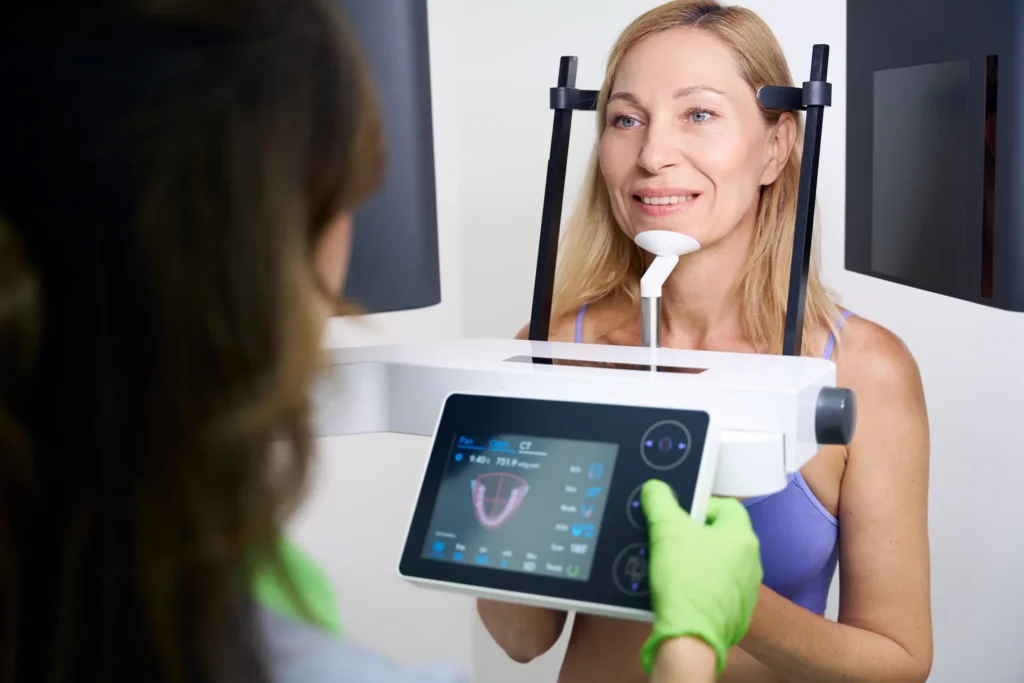
A cone beam CT (CBCT) scan — the same category of imaging used in hospital-grade diagnostics — produces a full volumetric, three-dimensional map of your jaw. At Vitality Dental, we capture this data in-house using our on-site CBCT scanner, so your imaging never leaves our office, and your planning never gets outsourced.
That scan is then merged with a digital impression of your teeth (an STL file from our intraoral scanner) to create a complete virtual replica of your mouth. Dr. Kung uses this digital model to plan your implant placement down to the precise angle, depth, and position — with the final crown already designed and accounted for. This is called prosthetic-driven planning: we engineer backward from where your tooth needs to end up, not just where the bone happens to be.
The plan is then used to 3D-print or mill a surgical guide — a custom-fitted device that fits over your teeth and physically constrains the drill to follow the exact path Dr. Kung mapped in the software. On surgical day, there is no improvisation. The guide does what months of planning told it to do.
The Digital Workflow: From Scan to Surgical Day
- CBCT Scan — Full 3D bone, nerve, and sinus mapping captured in-office.
- Digital Impression — Intraoral scan merges with CBCT data for a complete virtual model.
- Virtual Implant Planning — Dr. Kung positions the implant based on final crown design, bone density, and critical anatomy.
- Surgical Guide Fabrication — A precision guide is produced from the approved plan.
- Guided Surgery — The guide directs every aspect of the placement. Depth stops prevent over-drilling. Angulation is locked.
- Restoration — Because placement was optimized for the crown from the start, the final tooth fits, functions, and looks exactly as planned.
What Does “Guided” Actually Mean for Your Recovery?
This is where the technology stops being abstract and starts being personal.
Because the implant position is determined entirely in advance, surgical day is dramatically shorter. There’s no exploratory drilling, no repositioning, no extended time under anesthesia. Shorter chair time means less tissue trauma — and less tissue trauma is the single biggest driver of post-operative swelling, bruising, and pain.
In eligible cases — where bone volume and gum architecture allow — guided surgery also enables a flapless technique. Rather than cutting and folding back the gum tissue to expose the bone (the standard approach), a flapless procedure uses a small tissue punch to access the implant site directly. No incision. No sutures. Significantly less healing time.
This is a clinical nuance that most generic implant articles skip entirely, and it’s one of the most meaningful benefits for patients who are anxious about surgical recovery.
Most patients at Vitality Dental are surprised by how manageable the experience actually is — and that’s not an accident. It’s the result of planning that removes the variables that cause difficult recoveries in the first place.
Concerned about the procedure itself? We offer multiple levels of sedation to help you stay relaxed and comfortable throughout — from nitrous oxide to deeper options for more anxious patients. Your comfort is as important as your outcome.
Is 3D Guided Surgery Worth the Additional Cost?
This is one of the most common questions patients ask, and it deserves a direct answer.
Guided surgery typically involves an additional cost over freehand placement — primarily because of the CBCT imaging and the fabrication of the surgical guide. Whether that cost is included in your implant quote or itemized separately varies by practice; at Vitality Dental, we walk through every line item with you so there are no surprises.
What you’re paying for is the elimination of surgical guesswork. According to research published in peer-reviewed implantology literature, computer-guided placement has been shown to reduce implant positioning error compared to freehand techniques, which directly affects long-term success rates, the fit of your final crown, and your recovery experience.
For most patients in Plano who are investing $3,000–$5,000+ in a permanent tooth replacement, the margin for error is not something they want to negotiate on. The guide is not a luxury. It’s the engineering that protects the investment.
Does Guided Surgery Completely Prevent Complications Like Nerve Damage?
Straightforwardly: no surgical procedure carries a zero-risk guarantee, and it would be misleading to suggest otherwise.
What 3D guided surgery does do is give Dr. Kung a pre-surgical, three-dimensional view of the inferior alveolar nerve and maxillary sinus — the two anatomical structures most associated with implant complications. The virtual plan establishes safe margins from those structures before any drilling occurs. The surgical guide then physically enforces those margins during the procedure.
This does not make nerve involvement impossible. It makes it substantially less likely by replacing real-time estimation with pre-planned, precision-controlled placement. There is a meaningful clinical difference between those two things, and it’s why implantologists increasingly consider guided surgery the standard of care for complex cases.
If you have questions about your specific anatomy or risk profile, that conversation happens during your consultation — with full 3D imaging in hand, not after a flat X-ray and a best guess.
Who Is a Candidate for Guided Implant Surgery?
Most patients who qualify for dental implants are also candidates for the guided approach. The technique is particularly well-suited for:
- Single-tooth replacements where precision angulation affects the visible crown margin
- Multiple implants where consistent spacing and parallelism are critical
- Full-arch cases (such as All-on-4), where the entire bite is being reconstructed, and every degree of angulation has downstream consequences
- Patients with limited bone volume, where the implant must be positioned to maximize what’s available without encroaching on nerves or sinuses
- Patients with higher anxiety who benefit from shorter, more predictable surgical appointments
The CBCT scan is the qualifying step. Once we have your 3D data, Dr. Kung can determine whether a flapless approach is possible or whether a traditional flap with guided placement is the appropriate protocol for your anatomy.
Why Vitality Dental Patients in Plano Choose This Approach
There is no shortage of dental offices in the DFW corridor offering implants. What separates a guided implant experience from a conventional one isn’t marketing language — it’s whether the practice actually owns and operates the imaging technology, performs the planning in-house, and has the clinical training to execute it.
At Vitality Dental on Coit Road, the CBCT scanner, the intraoral scanner, and the surgical suite are all under one roof. Dr. Kung holds a Fellowship from the Academy of General Dentistry — a distinction earned by fewer than 6% of dentists — and a Fellowship Award from the International Congress of Oral Implantologists. Complex implant cases that other Plano-area offices refer out are handled here, in the same office where you had your consultation.
Over 1,000 five-star Google reviews reflect something simple: patients who were anxious about implants, who had been told their case was “complicated,” who had driven across North Texas seeing specialists — they found that the technology and the team made the process far more manageable than they expected.
That’s the point of all of it. The 3D scan, the surgical guide, the digital workflow — none of it is about looking high-tech. It’s about giving you a predictable outcome and a recovery that doesn’t derail your week.
What To Do Next
You’ve done the research. Let’s look at your specific anatomy together.
The only way to know whether you’re a candidate for guided implant surgery — and what your recovery might realistically look like — is a 3D scan and a conversation with Dr. Kung. We’ll show you the imaging, walk through the plan, and give you a clear picture of what to expect before you commit to anything.
Vitality Dental is located on Coit Road in Plano, with free surface parking right in front of Suite 106.
We’re open Monday–Friday, 7 AM–3 PM, with same-day consultations available.
Schedule Your 3D Scan Consultation →
Or call us directly — we’re real people, and we’re happy to answer your questions before you ever book an appointment.

 Sleep Dentistry for Smile Makeovers in Plano, TX