

Key Takeaways
- Anxiety-friendly dentistry in Plano combines trauma-informed psychological techniques, multiple sedation options (nitrous oxide, oral conscious, IV), and micro-invasive technology like The Wand and laser dentistry to eliminate common fear triggers.
- You control the pace: At Vitality Dental, you can stop treatment at any time using non-verbal signals, schedule consultation-only visits with no exam required, and choose your sedation level based on comfort—not just clinical necessity.
- Safety meets Texas standards: Our sedation certifications align with American Dental Association guidelines, and we coordinate with Texas Health Presbyterian Hospital Plano for medically complex cases.
- Plano-accessible care: Located at 1220 Coit Rd near Medical City Plano, we serve the Shops at Legacy, Willow Bend, and surrounding communities with multilingual support and transparent insurance guidance.
What Makes a Dentist “Anxiety-Friendly” in Plano?
An anxiety-friendly dentist in Plano doesn’t just offer sedation—they rebuild trust through trauma-informed care protocols that treat dental fear as a legitimate medical concern, not a character flaw.
At Vitality Dental, we understand that visiting the dentist can feel daunting, especially if you’ve avoided care for years due to shame, past negative experiences, or phobias like needle fear or an uncontrollable gag reflex. You have absolutely nothing to be ashamed of. Dental anxiety affects an estimated 36% of Americans, with 12% experiencing extreme fear that prevents routine care.
Here’s how anxiety-friendly dentistry differs from standard care:
- Psychological desensitization techniques: We use the “Tell-Show-Do” method, where every instrument and step is explained and demonstrated before it touches your mouth.
- Patient-controlled pacing: You establish a non-verbal “stop” signal (like raising your left hand) before we begin. Treatment pauses immediately when you signal—no questions, no pressure.
- Pre-appointment consultations: You can schedule a meet-and-greet in our office near the Dallas North Tollway without any clinical exam. Walk through the space, meet our team, ask questions, and leave. No drills, no X-rays, no obligation.
- Sedation as standard care: We offer four tiers of sedation—from mild nitrous oxide to hospital-grade general anesthesia—calibrated to your anxiety level, not just procedure complexity.
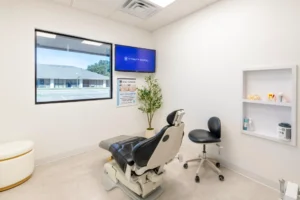
Our boutique, high-touch model means longer appointment blocks, soundproofed treatment rooms, and a team trained in recognizing trauma responses. We also coordinate with Texas Health Presbyterian Hospital Plano for patients with complex medical histories.
If you’re searching for a gentle dentist in Plano who treats fear as seriously as cavities, our approach bridges clinical precision with emotional safety.
Your First Visit: What to Expect Step-by-Step
Uncertainty amplifies anxiety. Knowing exactly what will happen—and what won’t happen without your consent—can lower your stress before you even arrive.
Before You Arrive
You control the agenda. When you call our office at 1220 Coit Rd (accessible via the Sam Rayburn Tollway or Dallas North Tollway), our scheduling team will ask:
- “Would you like a consultation-only visit, or are you comfortable with an exam today?”
- “Do you have specific triggers we should know about?”
- “Would sedation help you feel more at ease?”
We’ll send digital intake forms so you can complete paperwork at home, reducing waiting room time. Financial transparency upfront: We discuss our in-house dental plan (no deductibles, no yearly maximums, immediate eligibility) or payment options before any treatment is recommended.
At Check-In & During Your Exam
Our Willow Bend and Gleneagles patients often mention the calming environment—soft lighting, noise-canceling headphones at the front desk, and aromatherapy diffusers.
You’ll meet your dental assistant first, not the dentist. They’ll show you the treatment room, explain the equipment, and confirm your “stop” signal. You will not be ambushed.
Dr. Kung—a Plano native and Plano Senior High graduate—begins every exam with a conversation, not a mirror. He’ll ask about your goals, your fears, and what success looks like for you. Having personally undergone extensive dental treatment, he understands the vulnerability of sitting in that chair.
If at any point you feel overwhelmed, raise your hand. We stop, give you a break, and resume only when you’re ready. Some patients need five breaks during a 20-minute exam. That’s fine. Your comfort is as important as your smile.
After Your Appointment
You’ll receive a written treatment plan with prioritized recommendations, cost estimates with insurance breakdown, sedation options, and timeline flexibility. We never pressure you to schedule everything immediately. Many anxious patients start with a single filling, build trust, then return for comprehensive care.
Sedation Options: From Nitrous Oxide to IV Sedation
Sedation dentistry in Plano isn’t one-size-fits-all. At Vitality Dental, we tailor sedation to your anxiety level, medical history, and procedure complexity.
Nitrous Oxide (Laughing Gas)
How it works: Inhaled through a small mask, nitrous oxide produces calm, euphoric sensations within 3–5 minutes. You remain fully conscious.
Best for: Mild to moderate anxiety, patients who need to drive themselves home (effects wear off within 5–10 minutes), and shorter procedures.
Safety note: Generally safe for patients with high blood pressure, though we monitor vitals continuously. Not recommended during the first trimester of pregnancy.
Oral Conscious Sedation
How it works: You take a prescribed pill (typically a benzodiazepine) 1 hour before your appointment. You’ll feel deeply relaxed and may not remember the procedure, but you’re still awake.
Best for: Moderate to severe anxiety, longer procedures, patients with needle phobia who want to avoid IV placement while awake.
Critical safety rules:
- You cannot drive for 24 hours. Texas law requires a responsible adult to escort you home.
- Fasting required: No food for 6 hours before.
- Medical screening: Not suitable for patients with severe sleep apnea or uncontrolled high blood pressure.
IV Sedation
How it works: Medication delivered directly into your bloodstream produces deep relaxation within seconds. You’re in a “twilight” state—responsive but amnesic.
Best for: Severe dental phobia, complex surgeries (wisdom teeth, implant placement), extreme gag reflex.
Safety protocols:
- Administered by a sedation-certified dentist or anesthesiologist
- Continuous monitoring: pulse oximetry, blood pressure, heart rate
- Recovery: 20–30 minutes in-office; drowsiness persists 4–8 hours
General Anesthesia
For: Patients with severe special needs, uncontrolled movement disorders, or extreme phobias, unresponsive to other sedation.
Where: We coordinate with Texas Health Presbyterian Hospital Plano. Dr. Kung has hospital privileges and works alongside board-certified anesthesiologists.
Is sedation safe for patients with high blood pressure?
Mild to moderate hypertension (controlled with medication) is typically compatible with nitrous oxide and oral sedation, though we may consult your physician. We monitor vitals every 5 minutes and follow American Dental Association sedation guidelines.
Technology & Amenities That Eliminate Fear Triggers
Anxiety-friendly care isn’t just sedation—it’s eliminating the sensory triggers that activate your fight-or-flight response.
The Wand: Computer-Controlled Anesthesia
The trigger: For many, it’s the anticipation of the sharp pinch and uncontrolled pressure of injection.
The solution: The Wand uses computer-controlled delivery to inject anesthetic at a slow, consistent rate that your tissue can absorb painlessly. It looks like a pen, not a syringe.
Patient feedback: “I didn’t even realize he’d numbed me. No pinch, no burning—just slight pressure.”
Laser Dentistry (No Drill Options)
The trigger: The high-pitched whine and vibration of a dental drill.
The solution: Our soft-tissue laser performs many procedures—gum reshaping, early cavity removal—without a drill. It’s nearly silent, causes minimal bleeding, and often requires no anesthesia.
Sensory Comfort Tools
Our state-of-the-art dental office near the Shops at Legacy includes:
- Noise-canceling headphones with streaming (you choose the playlist)
- Weighted blankets (deep pressure stimulation calms the nervous system)
- Aromatherapy diffusers (lavender, peppermint, or unscented)
- Adjustable lighting (we dim overhead lights to reduce visual overwhelm)
- Private, soundproofed treatment rooms
We also offer scheduled “quiet hours” on Tuesday and Thursday mornings—reduced staff chatter, minimal sensory input—for patients with sensory processing sensitivity.
How We Address Specific Phobias
Your fear has a specific origin. Effective treatment requires addressing your trigger.
Needle Phobia (Trypanophobia)
Our approach:
- Desensitization: We show you the needle (if you want), explain its gauge size (we use 30-gauge—the thinnest available)
- The Wand alternative: Eliminates the “syringe” visual
- Sedation first: Oral sedation before IV placement, so you’re calm during needle insertion
- Topical anesthetic: Applied 3–5 minutes before injection
Gag Reflex Management
Our approach:
- Positioning adjustments: Sitting more upright reduces the sensation
- Topical anesthetic spray: Numbs the soft palate and back of tongue
- Breathing techniques: Steady nasal breathing reduces reflex sensitivity
- Sedation: Nitrous oxide or oral sedation significantly dampens the reflex
For extreme cases, we break procedures into multiple short appointments or use IV sedation.
Sensory Processing Sensitivity
Our approach:
- Pre-visit sensory profile: We document specific triggers in your chart
- Advance warning for every step: “I’m going to touch your cheek now.”
- Visual schedules: Laminated card showing appointment sequence
- Comfort items welcome: Stuffed animals, fidget tools, noise-canceling headphones
Past Trauma Recovery
Our trauma-informed approach:
- Acknowledgement: “What happened to you was not okay.”
- Re-establishing control: You set the pace. You can stop at any time.
- Transparent communication: We explain the “why” behind every recommendation
- Graduated re-exposure: Start with consultation-only, progress to cleaning, build trust
Meet Your Vitality Dental Team
Dr. Andrew Kung, DDS
Fellowship, Academy of General Dentistry (FAGD) | Fellowship, International Congress of Oral Implantologists (FICOI)
A Plano native and Plano Senior High graduate, Dr. Kung earned his Fellowship in the Academy of General Dentistry—achieved by only 6% of general dentists nationwide. He’s certified in multiple sedation modalities and has completed advanced training through the American Academy of Facial Esthetics. His personal experience with extensive dental treatment gives him unique empathy for anxious patients.
Our Team Philosophy:
We cater to those with dental phobias. Our passionate, caring team wants you to feel empowered on your oral health journey. We speak your language—English, Japanese, Chinese, Spanish, and Korean—and we’ve built our practice around helping you feel safe, heard, and in control.
Frequently Asked Questions
Do you offer consultations without an exam?
Yes. You can schedule a consultation-only visit with no clinical exam, no X-rays, and no treatment. Meet our team, tour our office, ask questions. No charge, no obligation.
What’s the difference between “sleep dentistry” and conscious sedation?
“Sleep dentistry” usually refers to IV sedation or general anesthesia (deep twilight or fully unconscious). Conscious sedation (nitrous oxide, oral sedation) means you’re awake and responsive but deeply relaxed.
Will my insurance cover sedation?
It depends. Most Texas plans cover sedation for documented anxiety disorders, special needs, or complex surgeries. We provide complimentary insurance verification before your appointment—no surprises.
“Sleep dentistry” usually refers to IV sedation or general anesthesia (deep twilight or fully unconscious). Conscious sedation (nitrous oxide, oral sedation) means you’re awake and responsive but deeply relaxed.
Can I drive after oral sedation?
No. Texas law requires a responsible adult to drive you home and stay with you for at least 4 hours. Benzodiazepines impair reaction time for 6–12 hours, even if you “feel fine.”
How much does sedation cost in Plano?
- Nitrous oxide: $75–$150 per appointment
- Oral conscious sedation: $250–$500
- IV sedation: $500–$1,200
- General anesthesia: $1,500–$3,000+
No insurance? Our in-house dental plan includes discounted sedation rates with no deductibles or yearly maximums.
No. Texas law requires a responsible adult to drive you home and stay with you for at least 4 hours. Benzodiazepines impair reaction time for 6–12 hours, even if you “feel fine.”
What To Do Next: Schedule Your Consultation
If you’ve read this far, you’re already taking the first step. You have absolutely nothing to be ashamed of. Dental anxiety is real, valid, and treatable.
Here’s how to get started:
- Call our Plano office: (214) 556-0855
- Visit us online: Schedule your new patient appointment
- Find us: 1220 Coit Rd #106, Plano, TX 75075
Located right after Medical City Plano, serving the Shops at Legacy, Willow Bend, Gleneagles, and the surrounding North Dallas communities.
What to expect when you call:
- No pressure to schedule treatment immediately
- Transparent discussion of costs and insurance
- Option to start with just a consultation
- Multilingual support (English, Japanese, Chinese, Spanish, Korean)
Your comfort is as important as your smile. Whether you need a routine cleaning or have avoided the dentist for years, our boutique, high-touch approach ensures you’re never just a number. Let’s take this first step together.
New patients and emergency appointments are welcome.

 Plano Emergency Toothache Guide (Night & Weekend)